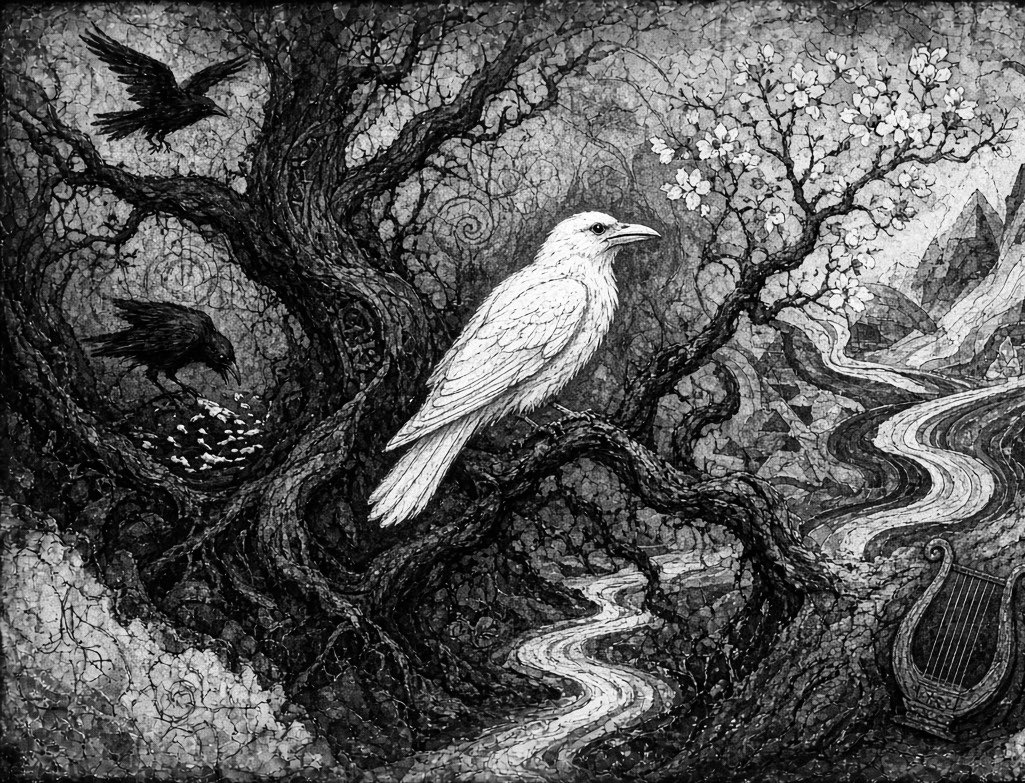
Late, you see the white and wily crow
He finds you lost among the dyads
In groves; and fields of flowers sown
All thrown in free, but grown so glad
The light ensnared in timbers hard
(By providence so rose the bard)

Still, one walks the path where ravens reap
But White he walks the woods entire
Days: dead against some bark in sleep
But sings from dreams with poet’s lyre
Away the night and lights secure
So forest becomes, for forester pure

As feelings come to mind
to thoughts ever possessed
of forms beyond the lined
areas, of life so blessed;
The rivers, mountains, plays
of dangerous delight,
                                          Which say,
This is my forest, or my father’s, or his before.
If only I had wings or was the sun or sky
Then all my forest I might see outside
My thoughts—which tender cares do want—
And keep for ever more.
©2026 R.A.R. Knight
Author’s Note:
The poem is not directly communicating William James metaphor of the “White Crow” summed up as: “If you wish to upset the law that all crows are black, you mustn’t seek to show that no crows are; it is enough if you prove one single crow to be white.”
But rather the white crow functions here as a figure of insight, drawing on the motif: the ‘white crow’ that overturns the generalization that all crows are black. Here the bird appears elusive (“wily”) and revelatory and opens a different mode of being.
The white crow moves differently through the same forest and moves through the whole wood rather than the limited path of ordinary experience. It provides insight into it and becomes associated with a more complete and purer perception of the forest, of life itself. The white crow works as a metaphor for the sudden, rare, and transformative insights that reorient one’s relation to the world.

Leave a Reply