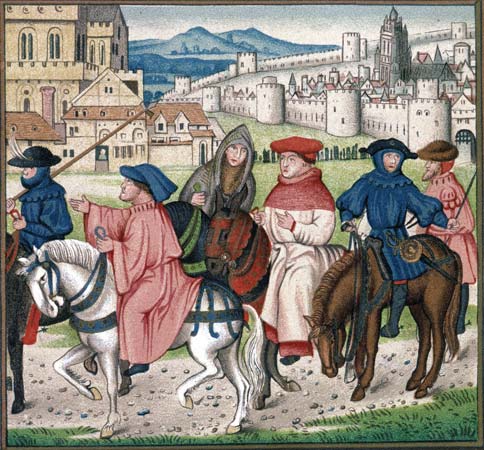
Here begins the Book of the Tales of Canterbury
When that April with his showers soothe
The drought of March, and pierces to the root
And bathes then every vein in sweet liquor
Of which virtue engendered is the flower;
When Zephirus then blows and sweetly breathes
And inspires in every wood and heath
The tender saplings; and the younger sun
Has in the Ram his partial course so run,
That small songbirds sing with musical rhymes,
To sleepers all the night with open eyes
(So nature pricks them and encourages);
Then people long to go on pilgrimages,
And palmers feel the pull to stranger strands,
To far-off halls, they know in foreign lands;
And specially from every shire’s end
Of England to Canterbury they wend,
The holy blissful martyr there to seek,
He who has helped whenever they were weak
Befell within that season, on a day,
In Southwark at the Tarbard as I lay
Ready to wend upon my pilgrimage
To Canterbury with full devout courage,
At night there came into that hostelry
Well nine and twenty in a company,
Of sundry people, wherein fate did fall
In fellowship, and pilgrims were they all,
And toward Canterbury would they ride.
The rooms and stalls were comfortably wide,
And more, a welcome mat we felt the best.
And shortly, as the sun had found its rest
So I had talked with each and every one
And so part of their fellowship become,
That early we all decided to rise,
To make our way and our tale devise.
Here bygynneth the Book of the Tales of Caunterbury
Whan that Aprill with his shoures soote
The droghte of March hath perced to the roote,
And bathed every veyne in swich  licour
Of which vertu engendred is the flour;
Whan Zephirus  eek with his sweete breeth
Inspired hath in every holt and heeth
The tendre croppes, and the yonge sonne
Hath in the Ram his halve cours yronne,
And small foweles maken melodye,
That slepen al the nyght with open ye
(So priketh hem nature in hir corages)
Thanne longen folk to goon on pilgrimages,
And palmeres  for to seken straunge strondes,
To ferne halwes , kowthe in sondry londes;
And specially from every shires ende
Of Engelond to Caunterbury they wende,
The hooly blissful martir for to seke,
That hem hath holpen whan that they were seeke.
Bifil that in that seson on a day,
In Southwerk at the Tarbard  as I lay
Redy to wenden on my pilgrymage
To Caunterbury with ful devout corage,
At nyght was come into that hostelrye
Wel  nyne and twenty in a compaignye,
Of sondry folk, by aventure yfalle
In felaweshpie, and pilgrimes were they alle,
That toward Caunterbury wolden ryde.
The chambers and the stables weren wyde,
And wel we weren esed atte beste.
And shortly, whan the sonne was to reste,
So hadde I spoken with hem everichon
That I was of hir felawshipe anon,
And made forward erly for to ryse,
To take oure wey ther as I yow devyse.
**This is an ongoing project— a translation from the Middle-English that attempts to keep the rhyme scheme, some older words and where possible the pentameter. There are notes and gloss words below that will be added to, now and then. The poem itself will run across many pages. The original Middle English was edited by F.N. Robinson. On a mobile phone this may be difficult if you want to compare line to line because of the columns so, turn the phone horizontally and the Middle English will sit beside the translation.
Notes:
Soote = sweet – I have replaced with soothe for a slant with root and moved sweet (see note 2) *Soote was archaic spelling for ME sweete
Swich=Such, but I prefer sweet in the line, see above note. It also goes with the west wind’s breath and I want to keep liquor (liquid/water/rain)
Zephirus (Latin Zephyrus, Greek Zephyros) is the classical god of the west wind. In Greek and Roman tradition he is the mildest and most benevolent of the winds — associated with spring, gentle breezes, and fertility.
Ram -The sun enters Aries (the Ram) at the spring equinox (around 21 March), so by the time the pilgrims set out, it has run half its course through that sign
Palmeres (singular: palmer) means palmers — a specific type of pilgrim who had travelled to the Holy Land (Jerusalem or Palestine). The name comes from the custom of these pilgrims carrying a palm frond (or palm branch) as a visible token or souvenir of their journey to the Holy Land.
Halwes– I have used halls in an ancient sense. The actual meaning of Halwes = shrines, holy places, sanctuaries (from Old English hālig “holy” + plural ending; related to modern “hallow”
Seeke = Sick
The Tabard was a real inn in Southwark. A “tabard” was a sleeveless coat or tunic, often worn by heralds or pilgrims. The inn was famous as a gathering place for Canterbury pilgrims.
Wel – The Middle English intensifier “wel” (meaning “very”, “quite”, “fully”, or “a good”) survives in modern English, particularly in informal British slang and certain dialects. E.g., “She’s well fit.” (attractive)
Forward – Here forward means a compact or arrangement [probably fore-word, their word therefore given]

Leave a Reply