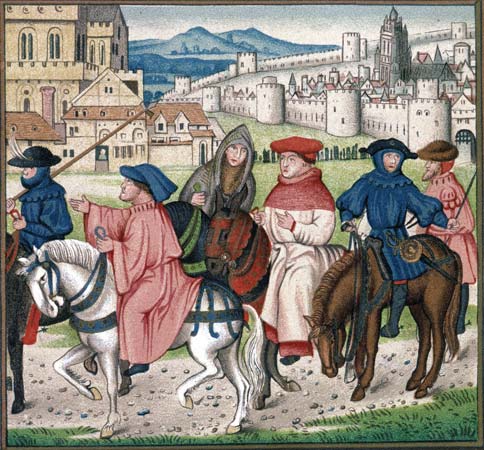
But nether less, while I have time and space,
Before I further in this tale pace,
I think it most accordant to reason
To tell you all about the condition
Of each of them, so as it seemed to me,
And who they all were, and their pedigree,
And too in what habits that they were in;
And with a knight then I will first begin.
A KNIGHT there was, and such a worthy man,
That from the time before he first began
To ride about, he loved all chivalry,
Truth and honour, freedom and courtesy.
And worthy was he in his master's war,
None farther had ridden, no man done more,
Or well in Christendom or in heathen-esse,
And ever honoured for his worthiness.
At Alexandria when it was won.
And often he was praised when feasts begun
Above all the foreigners in Prussia;
In Lithuania and in Russia,
No Christian knighted was so often seen.
In Granada at the siege had he been
Of Algezir, and rode in Belmaria.
At Layas was he and at Satalya,
When they were captured; and in the Great Sea
With many a noble army had he been.
Of mortal battles he had seen fifteen,
And had fought for our faith at Tramyssene
In the lists thrice, and slain were his foe.
This very worthy knight had been also
Sometime with the lord of Palatia
Against other heathens in Türkiye.
Always esteem he retained as a prize;
And more than worthy, he was also wise,
And carried himself as meek as a maid.
He did no villainy nor curses made
In all his life to no manner of wight.
But nathelees, while I have tyme and space,
Er that I ferther in this tale pace,
Me thynketh it acordaunt to resoun
To telle yow al the condicioun
Of ech of hem, so as it semed me,
And whiche they weren, and of what degree,
And eek in what array that they were inne;
And at a knyght than wol I first bigynne.
A KNYGHT ther was , and that a worthy man,
That fro the tyme that he first bigan
To riden out, he loved chivalrie,
Trouthe and honour, freedom and curteisie.
Ful worthy was he in his lordes werre,
And therto hadde he riden, no man ferre ,
As wel in cristendom as in hethenesse,
And evere honoured for his worthynesse.
At Alisaundre he was whan it was wonne.
Ful ofte tyme he hadde the bord bigonne
Aboven alle nacions in Pruce;
In Lettow  hadde he reysed  and in Ruce,
No Cristen man so ofte of his degree.
In Gernade at the seege eek hadde he be
Of Algezir , and riden in Belmarye .
At Lyeys  was he and at Satalye ,
Whan they were wonne; and in the Grete See
At many a noble armee hadde he be.
At mortal batailles hadde he been fifteen,
And foughten for oure feith at Tramyssene
In lystes thries, and ay slayn his foo.
This ilke worthy knight hadde been also
Somtyme with the lord of Palatye
Agayn another hethen in Turkye.
And everemoore he hadde a sovreyn prys;
And though that he were worthy, he was wys,
And of his port as meeke as is a mayde.
He nevere yet no vileynye ne sayde
In al his lyf unto no maner wight.
Notes:
Ferre – comparative form of ‘fer’ and means farther or further. Indicating greater distance, time or degree compared to something else
Lettow = Lithuania
Reysed – campaigned and fought; modern raised, as in the military sense ‘raised the city’
Algezir – modern city of Algeciras (Spain)
Belmarye – Marinid Sultanate (a region of Morocco/North Africa)- I have modified the spelling for modern tongue
Lyeys – medieval port city of Cilician Armenia. Now small town/historical site in Southeastern Turkey – I have used alternate Middle-English spelling Layas
Satalye – now major port city of Antalya, Turkey – I have modified Chaucer’s spelling for modern tongue

Leave a Reply